Henry Kissinger and the Yom Kipper War
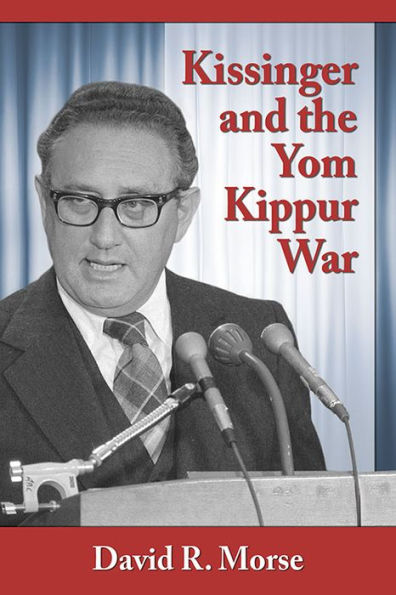
Kissinger and the Yom Kippur War Is available at:
Amazon
Barnes & Noble
the Google Play store, as well as
NOOK and
KINDLE e-reader
ISBN-13: 978-0786498642
ISBN-10: 0786498641
© 2015 David R. Morse
As the war–just two weeks in duration–played out along the Suez Canal, U.S. Vice President Spiro Agnew was forced to resign amidst bribery allegations. Watergate escalated, resulting in President Nixon’s near-breakdown. Despite Secretary of State Henry Kissinger’s efforts to supply arms to Israel, he was stymied by resistance in the Department of Defense, which some saw as overly provocative toward the Arabs. Ostensibly a U.S. foreign policy success, the war led directly to the 1974 oil crisis and a permanent rift in U.S.-Arab relations.
Drawing on Kissinger’s telephone conversations and recently declassified documents, this book tells the story of how the secretary became the chief architect of America’s Middle East policy, and how his Cold War strategy played a critical role in the decision to pursue active military involvement.
Watch the video summary of the book here:
To many American Jews of my generation, Arabs were akin to Nazis, and others who had persecuted our ancestors. To us, they had no legitimate grievances. Palestinians were not an occupied people. They, along with other Arabs, were our enemies, the most recent in a long line of abusers who wanted us dead. When the tides of war turned, thanks to a massive airlift of heavy arms orchestrated by the Nixon Administration, we were relieved. In the end, when the Arabs got pummeled, we were overjoyed. Henry Kissinger, a Jew who had just assumed the position of secretary of state, took the lead during the war, filling in for a devastated President Nixon overwrought by Watergate, was our hero.
Years later, as a graduate student in history, I took a keen interest in Middle Eastern history, specifically, what has been called the “special relationship” between the United States and Israel, which began, according to many scholars, with the Yom Kippur War. Since 1976, Israel has been the number one beneficiary of American foreign aid, totaling an average of $3 billion a year. Additionally, from a diplomatic perspective, Israel has benefited immeasurably from U.S. support in the United In terms of Middle Eastern diplomacy, since the Yom Kippur War, despite pretensions to evenhandedness, the United States has demonstrated unrelenting support for Israel.
Today, the relationship between the United States and Israel is stronger than ever, despite some rough spots under the Obama Administration. However, speaking as a Jew, my research into the war and its antecedents brought me to the realization that I had been wrong in how I viewed the Middle East. While there is plenty of blame to go around, Israel continues to build new settlements in territory occupied during the Six Day War, making it nearly impossible to pursue any kind of a Mideast solution. I have come to believe strongly that until the Palestinians are given back occupied land upon which to build a nation, peace in the Middle East is a virtual impossibility.
2. The Prelude to War
3. The Inadequacies of Diplomacy and Bureaucracy
4. The Tide Turns
5. Negotiating a Ceasefire
6. The Failure to Avoid a Superpower Confrontation
7. Aftermath
8. Chapter Notes
9. Bibliography
10. Index